Counting Carcasses: A Dirty but Essential Job
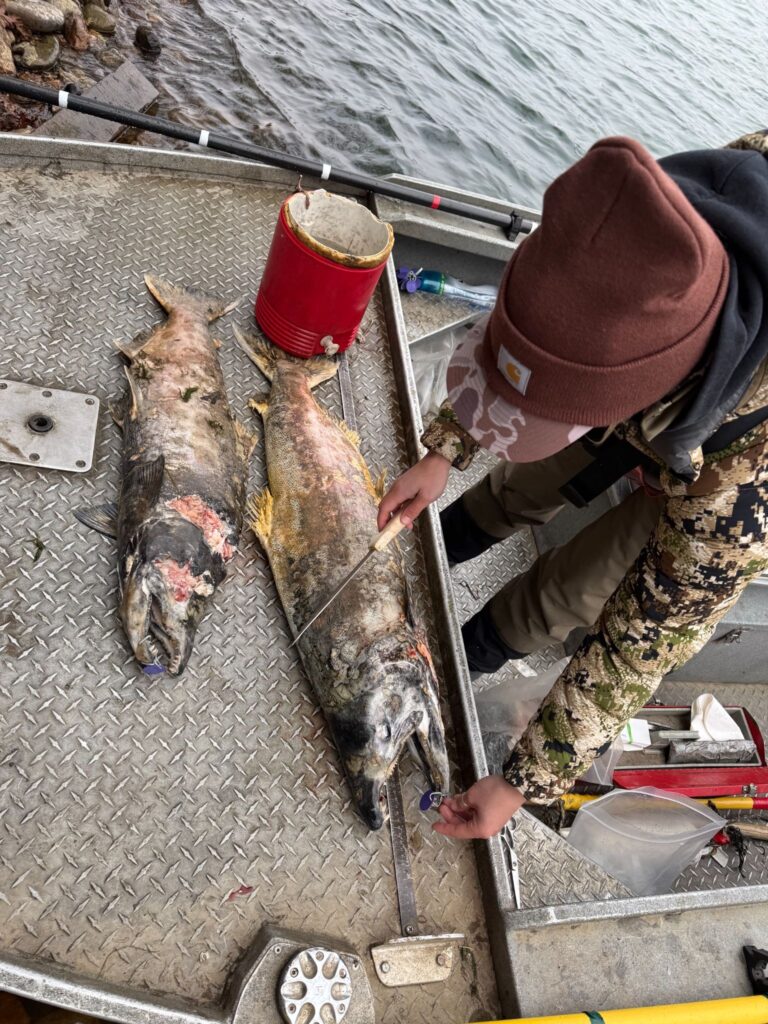
It’s a dirty job, but someone has to do it. The job is to count the carcasses of dead, spawned-out salmon to determine how many left the ocean and returned to the Central Valley to spawn and die. Turns out there is a crew of people who work with the Pacific States Marine Fisheries Commission who get paid to do this work. GSSA executive director Vance Staplin got to tag along for a day of counting to see how it’s done.

From Clipboards to GPS: How Carcass Surveys Work Today
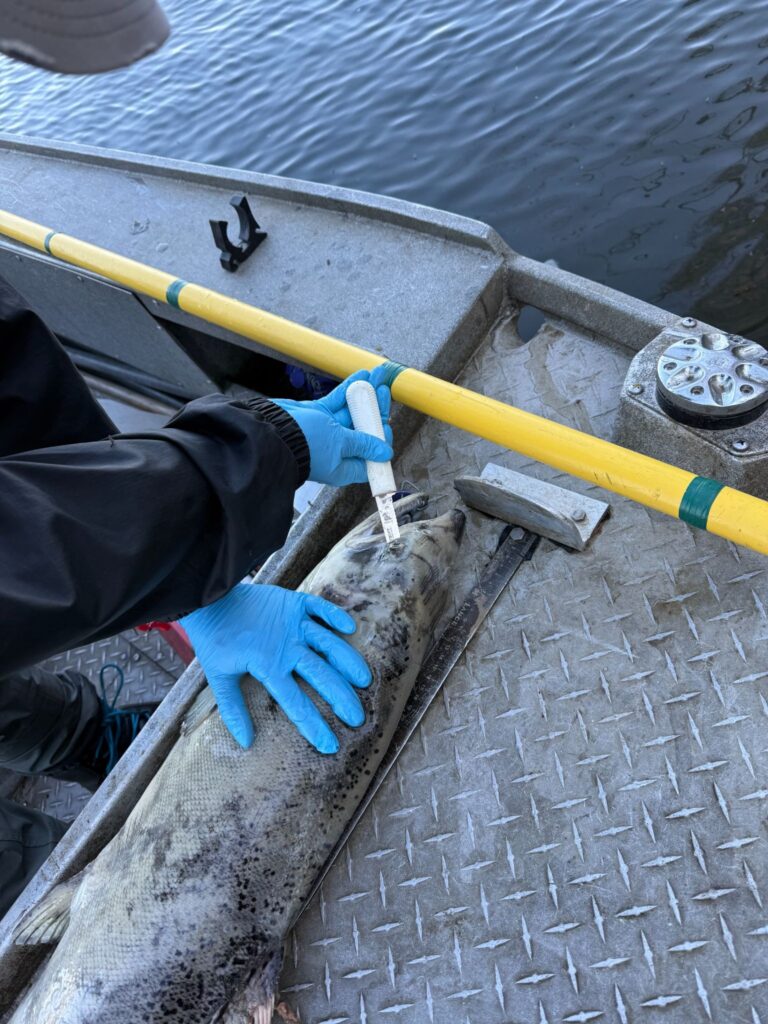
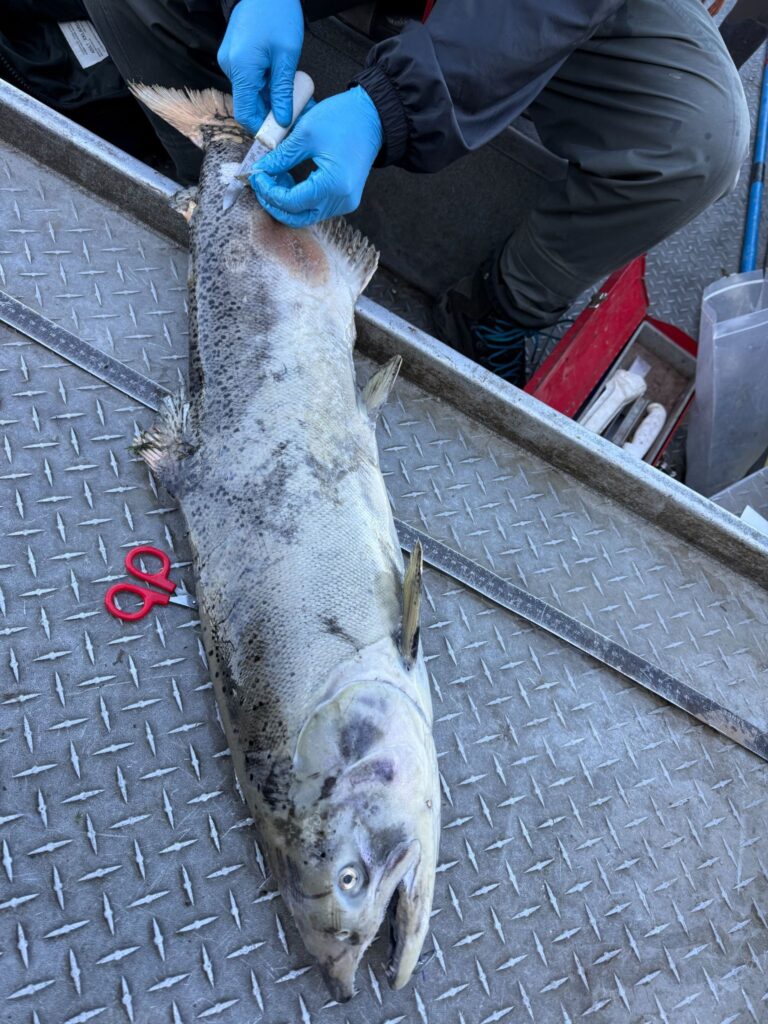
It used to be that carcasses were counted, a rough note of where in the river they were encountered, and then cut in half and dumped back into the river again so they wouldn’t be counted twice. These days, GPS coordinates can be used to locate where a carcass was counted. A few are tagged and returned to the river to see if they get re-sampled. Based on the quality of the carcass, surveyors collect various parts of the fish that can determine where that fish was reared as a juvenile and what part of the ocean it lived in during adulthood. The parts collected range from “ear bones” or otoliths, to eyes, to scales, and the snout of fish marked as hatchery fish by the absence of their adipose fins.
Otoliths: Ear Bones That Tell a Salmon’s Life Story
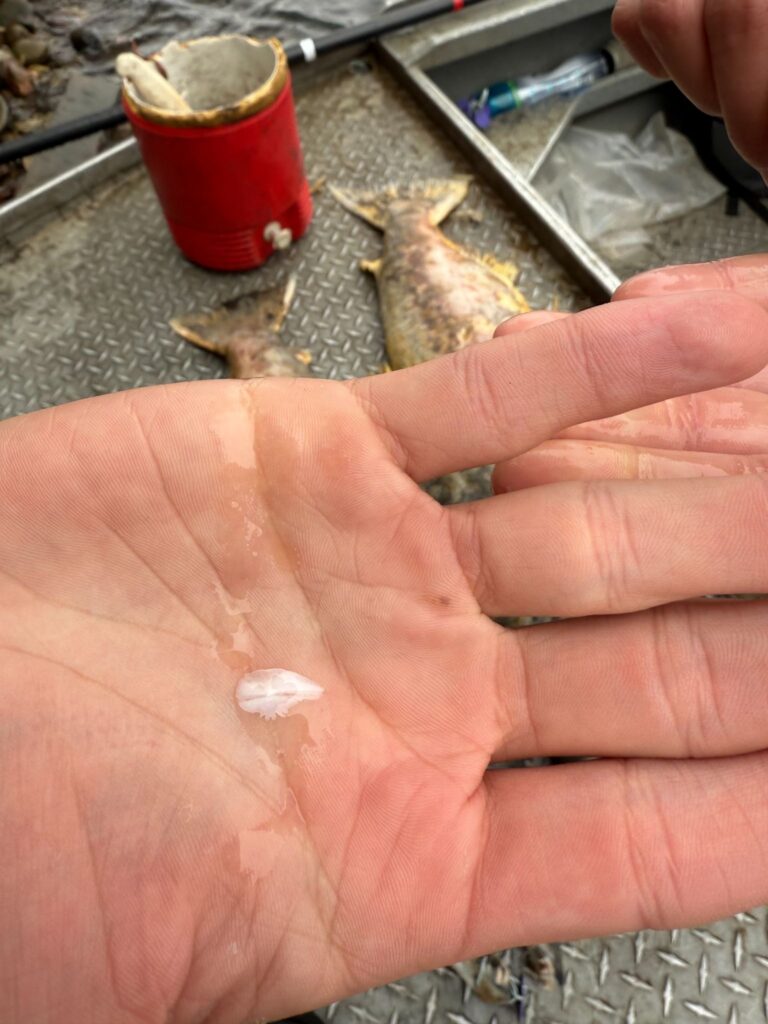
The otoliths, or ear bones of the salmon, contain chemical clues to where that salmon spent its youth and where it spent its life in the ocean. They are crucial for balance, hearing, and sensing water movement. Still, they’re also invaluable life-history records, growing in daily rings that capture chemical signatures of a salmon’s environment, acting like a biological diary for scientists to track survival, origins, and hatchery vs. wild status.
What Salmon Eyes Reveal About Diet and Habitat
Another organ the surveyors sometimes collect is the eyes. Salmon eyes also serve as a life journal, revealing what a fish ate and its migration patterns through stable isotope analysis of eye-lens layers (like tree rings). Scientists can uncover a salmon’s early diet (plankton, insects), its use of crucial habitats like floodplains, and even distinguish hatchery from naturally spawned fish by analyzing the unique chemical “fingerprints” locked in these protein-rich tissues.
Tissue, Scales, DNA, and Identifying Hatchery Fish
Tissue samples can provide DNA that might match that retained from adult hatchery spawners three years prior. Since only about 25% of hatchery salmon get their adipose fin clipped, the DNA analysis can help identify some of the other 75% of hatchery fish. Scales can help identify the age of the fish.
Yes, It Smells
If this sounds like smelly work, it is, according to Staplin, who admired the way the surveyors have learned to ignore the smell associated with their work.
Working the River: Boats, Gear, and Long Days
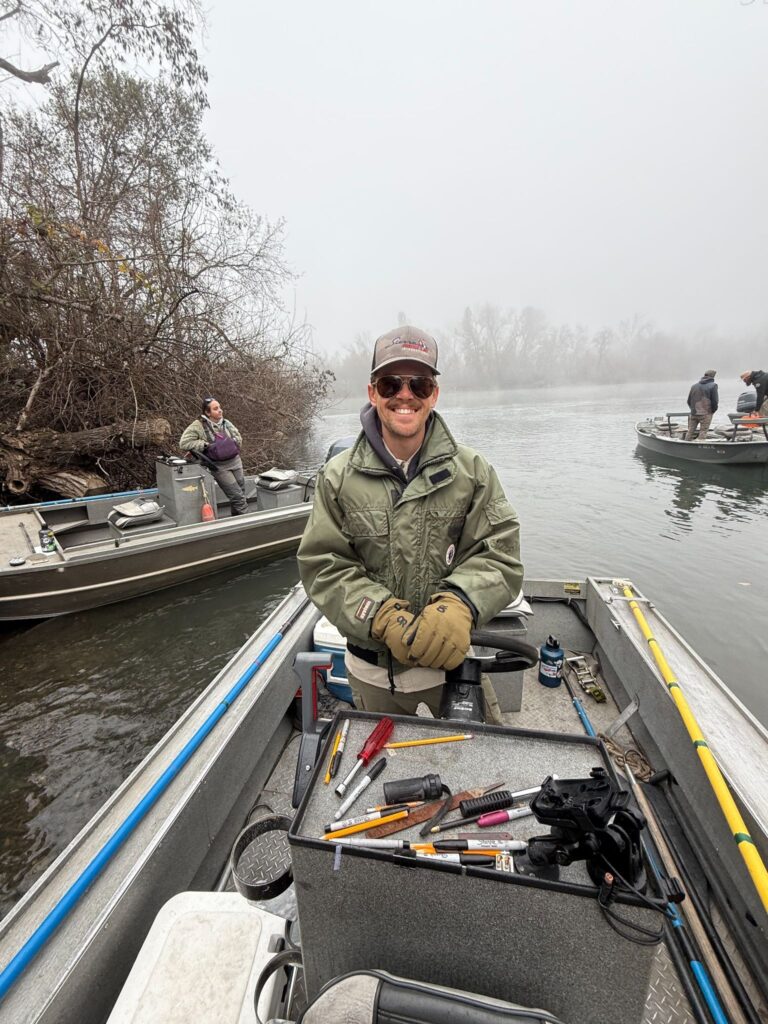
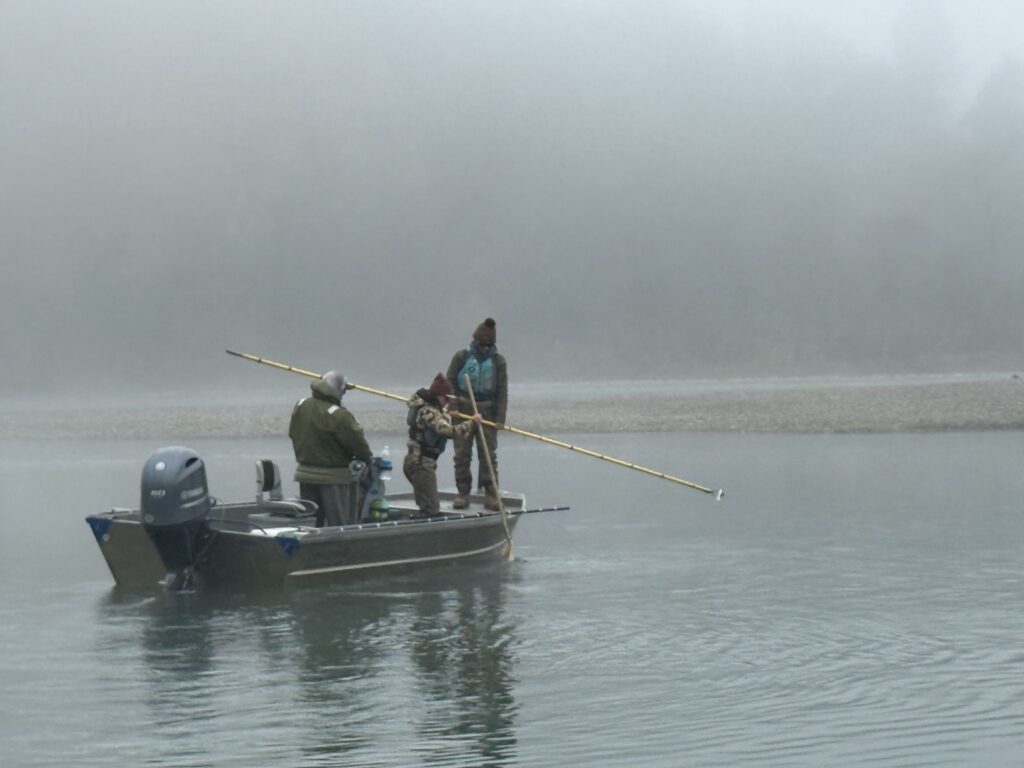
To collect the carcasses, the survey teams set out in 16-foot boats with jet drives, which allow them to work in very shallow water. They have a long pole with barbed prongs on the end for “harpooning” the dead salmon.
They map the river into well-defined sections to systematically survey and usually use two boats. On the day Vance was along, they launched on a very cold morning at the Posse Grounds Boat Launch in Redding, upstream of the Sundial Bridge. This part of the upper Sacramento River, just above Highway 44 in Redding, holds lots of carcasses in the flows and eddies from fish that spawn upriver.
Covering the River, and Accounting for What’s Missed
Over the season, surveyors will study roughly 27 miles downstream from the Keswick Dam to Balls Ferry. Salmon population experts know they aren’t going to recover and count every salmon that spawned and died. They’ve worked out a way to apply models to account for carcasses that are missed. Undercounting can be especially a problem when big storms dump large volumes of muddy runoff into the winter, but that hasn’t been a significant problem so far this counting season. Some of the salmon counted are tagged with a big, obvious metal ring before being tossed back into the river. This allows surveyors to make an informed calculation of how accurate their count is based on how many of these “re-tagged” carcasses they encounter again.
What a “Good” Counting Day Looks Like
Right after the height of the salmon spawn, surveyors can handle up to 200 carcasses a day. But when the carcasses are in good condition, they can take many more sample tissues (eyes, otoliths, scales, etc.), and it slows things down to the 150-carcass range.
Why This Work Matters, and Why GSSA Shows Up
Crews can be out for eight hours or more at a time, handling fish in cold water, to help all of us understand how the salmon population is really doing. The work Staplin joined will be tabulated with return numbers released to the public next February or March.
Counting dead salmon may not look like conservation, but it’s the foundation of it.
These carcass surveys are how we know whether salmon recovery efforts are working or failing. They inform water-management decisions, hatchery practices, fishery forecasts, and legal protections. Without accurate return data, we’re guessing. And guessing isn’t good enough.
GSSA shows up for this work because we believe science matters and because we want to be in the field and get to know the people doing the real work. Because policy decisions should be grounded in data collected on real rivers, by people willing to do the unglamorous work. And because the fishermen, tribes, communities, and families who depend on salmon deserve better than assumptions.
When those return numbers are released in late winter or early next spring, they’ll reflect thousands of hours of fieldwork, cold mornings, long days, and yes, some pretty unpleasant jobs, all aimed at one goal: making sure California’s salmon have a future.
That’s work worth supporting.
The kind of science-driven conservation described here doesn’t happen by accident. It takes time, expertise, and a commitment to showing up on cold mornings, on working rivers, and in the policy rooms where these numbers shape real decisions.
If you believe California’s salmon deserve management rooted in real data, not guesswork, you can help support this work by donating to the Golden State Salmon Association. Contributions help GSSA stay engaged in the field, in the science, and in the fights that determine whether salmon have a future in our rivers.
Support science-based salmon recovery: https://goldenstatesalmon.salsalabs.org/donation/index.html