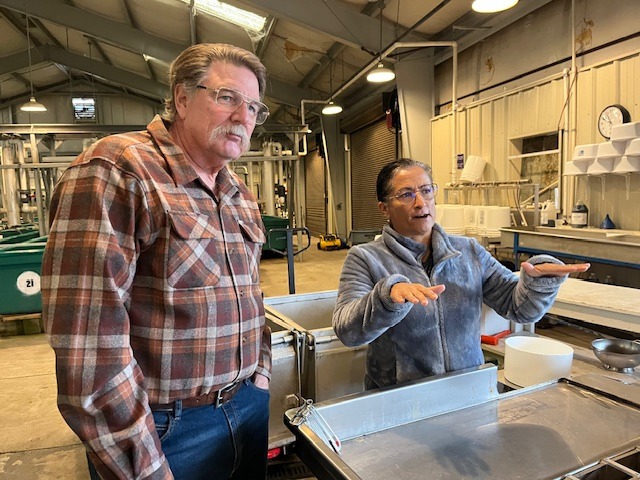
On a cold December morning, GSSA executive director Vance Staplin visited East Bay Municipal Utility District’s Mokelumne Hatchery, widely regarded as the state’s best-managed hatchery. There, he met with Michelle Workman, EBMUD’s Natural Resources Manager, who briefed him on several issues the district and hatchery are currently working on in partnership. Among them: the need for both agencies to invest in the infrastructure at the facility to support both the rearing of “enhancement” salmon, which are the State of California’s responsibility, as well as mitigation production, which is EBMUD’s responsibility.
Enhancement fish are explicitly raised to boost the fishery and are paid for through a combination of fees assessed on commercial and charter boats and state funds from sport-fishing license sales. Because the Mokelumne team, led by hatchery manager Bill Smith, has consistently demonstrated an ability to raise the strongest baby salmon at the lowest cost of any hatchery in the state, California has relied on the Mokelumne Hatchery to produce millions of enhancement salmon in recent years.
Workman explained that the water used by East Bay residents comes from the Mokelumne River and from Pardee Reservoir. Camanche Reservoir provides the hatchery water supply and downstream fishery flows. EBMUD funds the Mokelumne Hatchery to mitigate for the loss of upstream salmon habitat above those dams.
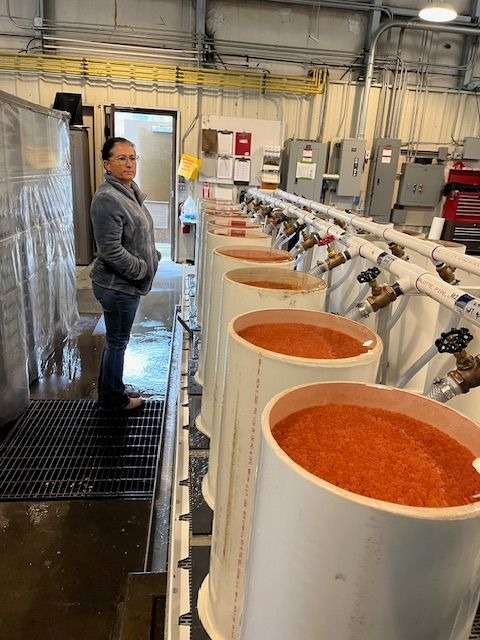
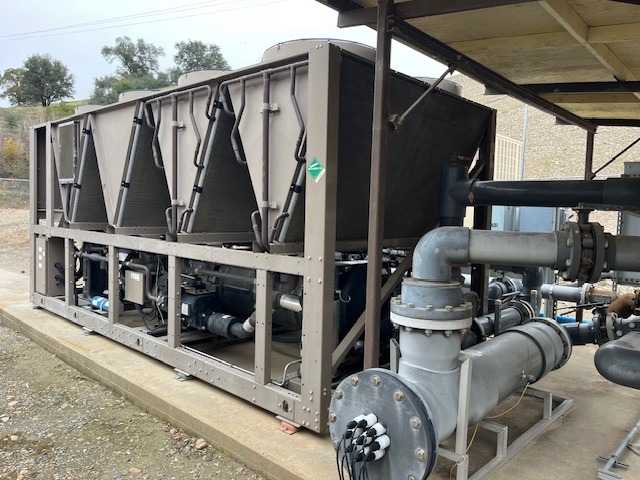
During the visit, Staplin got a close look at the water-treatment systems used to remove pathogens before water enters the hatchery, as well as the chiller units, essentially large refrigeration systems that keep hatchery water cold enough for successful operations. He and Workman also viewed millions of incubating salmon eggs recently collected from adult salmon returning to spawn. These eggs can be especially susceptible to disease, which can spread quickly in tightly packed incubators if pathogens enter the system.
Workman then walked Staplin down to the river below the hatchery, where shallow spawning areas have been engineered into the riverbed. These areas now attract some returning adult salmon to spawn naturally.
The two also discussed the most significant challenge facing baby Mokelumne salmon: migrating safely out of the river to the ocean. Most do not survive the journey past the massive Delta water pumps, which often pull so strongly that rivers flow backwards. In most years, young salmon anywhere near these pumps die, one reason EBMUD and hatchery managers truck hatchery-raised salmon to safer release sites in the Bay and Delta, west of the pumps’ lethal influence.
Staplin and Workman also discussed plans to bring baby salmon to a new acclimation net pen sponsored by GSSA in Richmond in early spring 2026. This effort builds on several years of partnership between GSSA and the state to release baby salmon near the old Richmond ferry terminal, which are often attended by groups of local kids who get an up-close look at salmon biology and a memorable ride aboard the charter boat Salty Lady.
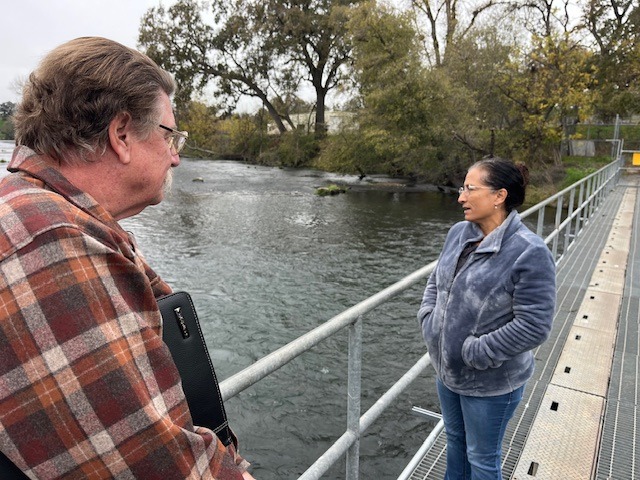
GSSA looks forward to continuing constructive projects in partnership with EBMUD and the Mokelumne Hatchery. Staplin was very grateful for the time Workman spent walking him through the river, the facility, and the critical work happening on the Mokelumne.
The Golden State Salmon Association (www.goldenstatesalmon.org) is a coalition of salmon advocates, including commercial and recreational salmon fishermen and women, businesses, restaurants, native tribes, environmentalists, elected officials, families, and communities that rely on salmon. GSSA’s mission is to restore California salmon for their economic, recreational, commercial, environmental, cultural, and health values.